
Performance Management
From Annual Appraisals to a Leadership System for Organizational Excellence
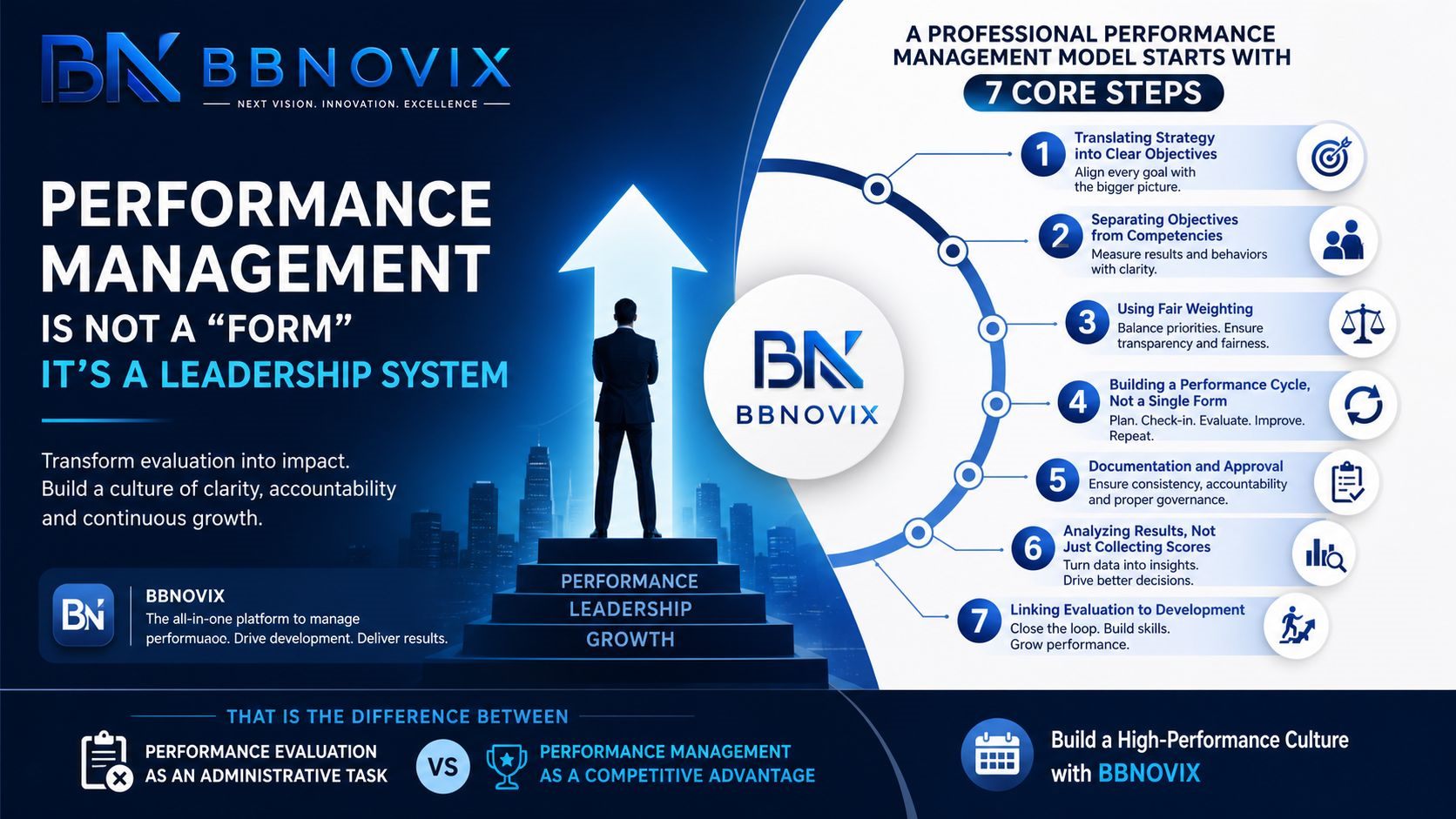
In many organizations, performance management is viewed as a periodic administrative procedure involving the distribution of employee appraisal forms, assigning performance ratings, approving results, and maintaining records in personnel files.
However, this approach reduces performance management to a single administrative activity while overlooking its true purpose: aligning organizational efforts, achieving strategic objectives, developing human capabilities, and continuously improving business results.
Performance management is not simply a form completed at the end of the year or a set of scores assigned to employees. It is an integrated and continuous management and leadership system that connects organizational strategy with operational objectives, individual performance, competencies, and development initiatives.
The fundamental distinction is that performance evaluation measures what has been achieved, while performance management guides what needs to be achieved, monitors progress, and continuously improves results.
Building an effective performance management system can be guided by seven interconnected core steps.
1. Translating Strategy into Clear Objectives
Effective performance management begins with organizational strategy, not employee appraisal forms.
It is impossible to evaluate departments and individuals objectively without establishing clear objectives that are aligned with the organization's strategic direction.
The first step is to translate the organization's vision and strategic priorities into corporate and operational objectives, then cascade them across departments, teams, and individual employees.
Every employee should understand how their responsibilities contribute to the organization's overall success.
This can be achieved through:
- Aligning individual objectives with departmental and strategic goals.
- Establishing measurable Key Performance Indicators (KPIs).
- Setting clear and time-bound targets.
- Defining responsibilities and expected outcomes for each role.
- Ensuring alignment and avoiding conflicting objectives across departments.
For example, if improving customer satisfaction is a strategic priority, this objective should be reflected in the responsibilities of relevant departments through measurable targets such as faster response times, improved service quality, fewer complaints, and a better customer experience.
This approach ensures that individual objectives are not isolated task lists but integral components of the organization's overall strategy.
2. Separating Objectives from Competencies
One common mistake in performance appraisal systems is confusing the results employees achieve with the way they perform their work.
Objectives measure outcomes and achievements, while competencies assess the capabilities, skills, and behaviors employees demonstrate when delivering those results.
- Objectives: Measure what employees are expected to achieve, such as completing projects, meeting targets, maintaining service levels, and improving productivity.
- Competencies: Measure how employees perform their responsibilities, including leadership, communication, teamwork, problem-solving, initiative, and professional conduct.
These two dimensions should be assessed separately because an employee may achieve numerical targets while demonstrating weaknesses in communication or collaboration. Another employee may demonstrate excellent professional and behavioral competencies but fail to deliver the expected results.
Evaluating both dimensions provides a more comprehensive and balanced understanding of employee performance, avoiding excessive reliance on numerical results or subjective impressions.
3. Using Fair and Transparent Weighting
Once objectives and competencies have been established, the next step is to determine the relative weight of each assessment component.
The purpose is to balance results with competencies and behaviors according to the nature of the position and its level of responsibility.
For example, an organization may adopt the following evaluation structure:
- Objectives and results: 70%.
- Competencies and behaviors: 30%.
These percentages are illustrative rather than universal standards. Weightings may differ depending on job requirements, professional responsibilities, and organizational priorities.
Operational positions may place greater emphasis on productivity and measurable results, while leadership positions may require greater consideration of leadership capabilities, decision-making, team management, and strategic contribution.
Effective weighting should be:
- Communicated clearly in advance.
- Relevant to the nature and responsibilities of each position.
- Consistent across comparable roles.
- Transparent and justifiable.
- Subject to appropriate governance and approval.
Fair evaluation does not necessarily mean applying an identical model to every employee. It means establishing objective and consistent criteria that reflect differences in roles and responsibilities.
4. Building a Performance Cycle, Not a Single Form
This is one of the most important elements distinguishing genuine performance management from traditional administrative appraisal.
Performance is not created at the end of the year. It develops throughout the year through planning, monitoring, coaching, feedback, and continuous improvement.
Organizations should therefore establish an ongoing performance management cycle consisting of:
1. Planning
Establishing individual objectives, KPIs, targets, expectations, and required competencies at the beginning of the performance cycle.
2. Regular Check-ins
Holding periodic meetings between managers and employees to review progress, discuss challenges, provide guidance and support, and address performance gaps.
3. Evaluation
Measuring actual results against agreed objectives and assessing competencies and behaviors using clear criteria and objective evidence.
4. Improvement and Development
Translating evaluation results into practical development plans, addressing performance gaps, and identifying professional and training needs.
5. Replanning
Using insights from the previous cycle to update objectives and expectations for the next cycle in line with changing organizational priorities.
This creates a continuous and repeatable process:
Planning → Monitoring → Evaluation → Development → Replanning.
5. Documentation, Approval, and Governance
An effective performance management system requires clear mechanisms for documentation, review, and approval.
Documentation is not simply about maintaining completed appraisal forms. It ensures transparency, provides evidence for decisions, and establishes reliable records that can be referenced when necessary.
Key documentation requirements include:
- Recording approved objectives and KPIs.
- Maintaining records of periodic reviews and feedback.
- Documenting evidence and justifications supporting evaluation results.
- Recording feedback provided to employees.
- Maintaining performance improvement and development plans.
- Approving results according to defined authority levels.
- Protecting appraisal records through appropriate confidentiality and data protection controls.
Organizations should also establish review mechanisms to reduce bias and unjustified inconsistencies between managers and departments.
An important practice is Performance Calibration, which involves reviewing evaluation results to promote consistency and fairness across departments and comparable positions, without imposing forced rating distributions.
6. Analyzing Results, Not Just Collecting Scores
A common weakness in performance management is that organizations consider the process complete once employee scores have been calculated or departmental performance reports have been generated.
However, the real value of performance management emerges when results are analyzed and transformed into insights that support better management decisions.
Important areas of analysis include:
- Reviewing performance levels across the organization, departments, and individuals.
- Identifying departments and roles experiencing performance gaps.
- Comparing actual results against strategic and operational targets.
- Analyzing the causes of underperformance and reduced productivity.
- Identifying competencies and skills requiring improvement.
- Recognizing high performers and employees with emerging leadership potential.
- Monitoring performance trends across successive evaluation cycles.
Dashboards, performance indicators, and statistical analysis can help transform raw data into meaningful insights, enabling leaders to establish priorities and make informed decisions.
An organization does not simply need to know who scored 90% or 70%. It needs to understand why those results occurred, what can be improved, and which decisions should follow.
7. Linking Evaluation to Development and Professional Growth
The true value of performance management lies in its ability to transform evaluation results into actual opportunities for development and improvement.
When an appraisal identifies a competency gap or a decline in a specific performance area, it should lead to a defined action to address that gap.
This can be achieved through:
- Developing Individual Development Plans (IDPs).
- Identifying training needs based on performance and competency gaps.
- Providing training, coaching, and professional mentoring.
- Assigning projects and responsibilities that build practical experience.
- Developing talent and future leadership pipelines.
- Monitoring the impact of development initiatives on actual performance.
Training should not operate as an activity disconnected from appraisal results. It should respond to identified needs, target specific competencies, and be linked to measurable development objectives.
Furthermore, performance results may inform career development, promotions, succession planning, and rewards, subject to organizational policies and applicable governance requirements. Such decisions should also consider fairness, transparency, and any additional criteria relevant to each decision.
8. From Performance Evaluation to a High-Performance Culture
When these steps are implemented as an integrated system, organizations can move beyond treating performance as a periodic administrative exercise and make it an essential part of their organizational culture.
This transformation is reflected in:
- Clearer objectives and expectations for employees.
- Stronger accountability and ownership.
- Improved communication between managers and employees.
- Evidence-based management decisions.
- Early identification and resolution of performance gaps.
- Continuous development of human capabilities.
- Stronger alignment between individual contributions and organizational results.
Achieving this transformation requires more than purchasing a digital performance management system or introducing an advanced appraisal form. It requires leadership commitment, clear policies, qualified managers, and an organizational culture that values continuous improvement.
Conclusion
Performance management is not an annual form or a set of scores assigned to employees. It is an integrated leadership system that begins by translating strategy into clear objectives, continues through competency assessment, fair weighting, and ongoing monitoring, and ultimately transforms performance results into opportunities for development and improvement.
The difference between an organization that merely evaluates performance and one that genuinely manages it lies in how it uses the results.
The former collects and documents scores, while the latter analyzes them, learns from them, and uses them to shape future decisions.
True performance management is not limited to measuring what employees have achieved. It empowers them to achieve better results, build stronger capabilities, and transform individual performance into sustainable organizational value.
Performance management is not merely an administrative task. It is a leadership system that creates clarity, strengthens accountability, and drives organizational growth and excellence.